Business
Get to the decision, with the numbers behind it.
How SlateData helps organizations turn their analysis into a clear business review that leadership can read, question, and act on.
A leadership review needs more than a set of charts. It needs a clear account of what happened, the evidence behind that account, and the decision the organization is asking you to make. When those pieces arrive separately, the meeting can become an exercise in reconstructing the analysis.
SlateData gives your organization a connected path from source data to presentation. Analysts can investigate and validate the numbers in a workspace, then assemble the charts and explanation into a deck. You can read the result in SlateData, PowerPoint, or PDF, depending on how your organization shares the review.
Put the business question at the center
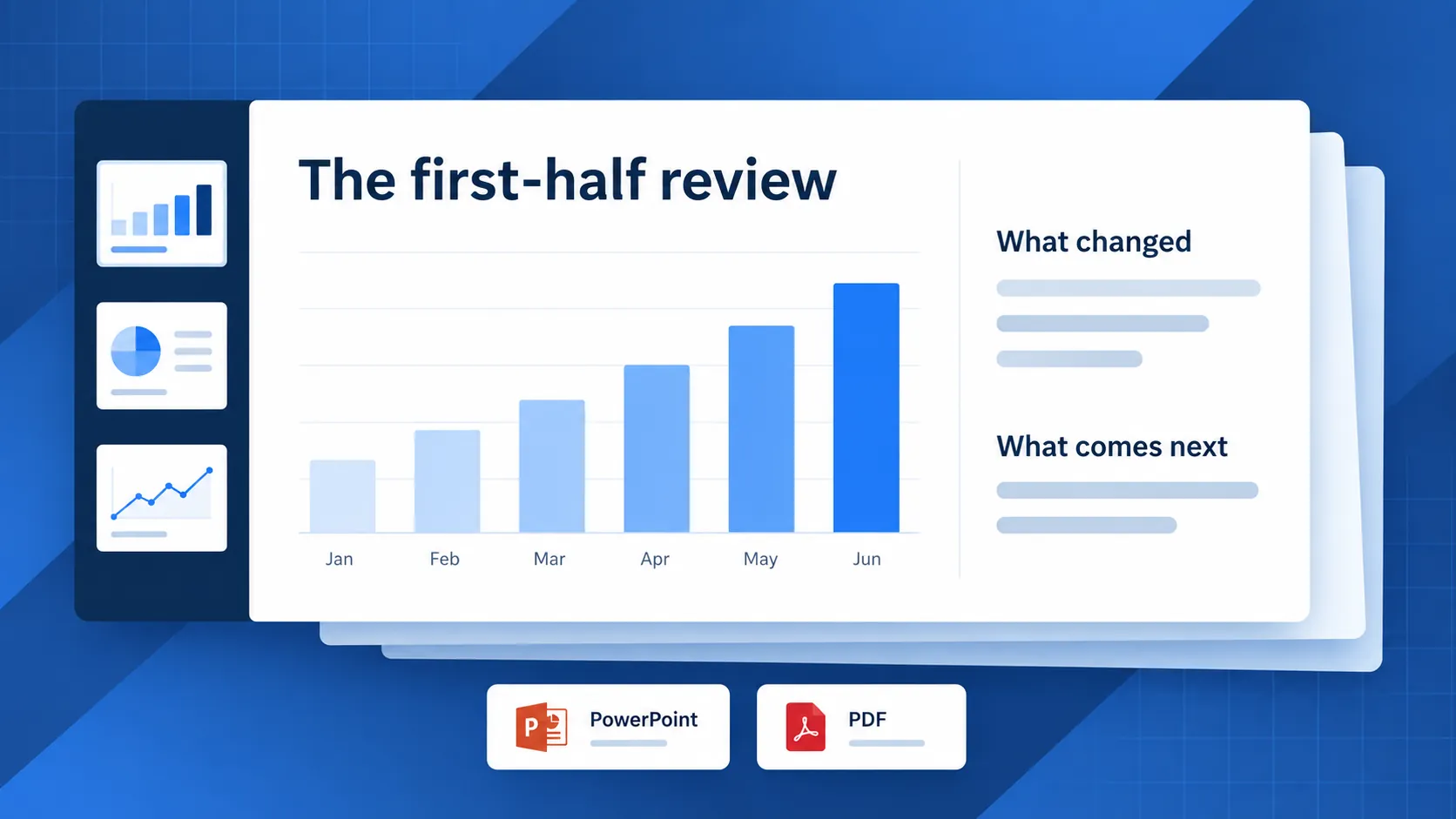
Imagine a first-half revenue review. “Revenue increased” describes an outcome, but it does not tell you whether to expand a program, investigate a weak region, or adjust a target. The presentation needs to connect the trend to the questions that affect those choices.
In SlateData, the organization can arrange saved visualizations alongside written headings and commentary on a slide. That makes room for the interpretation beside the evidence: what changed, which segments contributed, and what remains uncertain. The software provides the building blocks; your organization supplies the business judgment.
When workspace AI is enabled, the organization can generate a cover slide with a draft overview based on the deck’s content. It is an editable introduction to the work, which the organization can review and sharpen before sharing. The recommendation still needs to reflect what the analysis actually supports.
Keep the evidence within reach
A concise presentation should not make the calculation impossible to inspect. SlateData’s visualization view includes access to the underlying data and query. The analyst can return to the saved work when you ask how a measure was calculated or why one segment looks different.
For the revenue review, a useful follow-up might be: “Does this include refunds?” or “Would the pattern hold if we excluded the largest customer?” With the source and query available in the workflow, those questions can lead to a revised analysis rather than a debate over a pasted chart.
This visibility supports a better review process, but it does not certify a metric by itself. Your organization still needs to agree on definitions, check the source, and explain limitations. SlateData makes the analytical work available for that discussion.
Be clear about which numbers you are reviewing
A connected analysis and a meeting record serve different purposes. The organization may want to refresh a chart as new data arrives during preparation, then hold the figures steady once the review is ready.
SlateData supports refreshing connected visualizations and verifying them, which freezes their data. Ask the organization to settle on the reporting period, confirm the figures, and freeze the relevant charts when the meeting needs a stable reference. A later update can become a deliberate revision instead of an unexplained change between preparation and presentation.
Read the review in a familiar format
Your organization can export the deck as PowerPoint or PDF, so reading the final presentation does not require learning an analysis tool. PowerPoint keeps text editable for adjustments to the narrative; the charts arrive as images. PDF provides a fixed version for circulation.
An exported file is a snapshot, not a live connection to the underlying data. If the analysis changes, the organization should export and share an updated copy. When reviewing inside SlateData, workspace access and roles determine who can view or change the work.
The result is a practical handoff: a presentation you can read on its own, with an analytical workspace your organization can return to when the next question comes up. Use the meeting to test the interpretation, weigh the tradeoffs, and decide what happens next.